
HORIZON RIO IMOBILIARIA LDTA
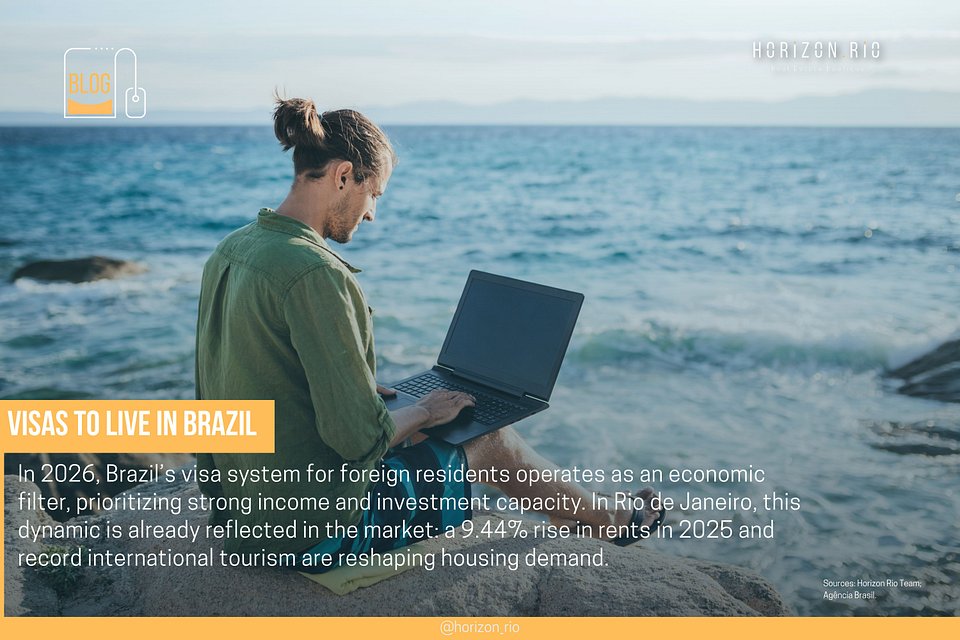
Which visas will allow you to live in Brazil in 2026 — and what the data reveals about where to live in Rio de Janeiro
Why do visas serve as a strategic market indicator?
The analysis of visas is usually treated as a legal issue. In globally integrated cities, however, it serves as a tool for economic analysis.
Each immigration category determines who is allowed to enter the country, their income level, and how long they may stay. This framework acts as a direct filter for financial profiles and spending habits, with rules set by bodies such as the Ministry of Justice and Public Security.
Unlike short-term tourism, regulated migration tends to generate demand characterised by longer stays, greater predictability and a direct impact on the property market.
This trend is already part of a measurable trend. In 2025, Brazil surpassed the 23 million mark for international tourists, establishing a more consistent flow of visitors and a significant increase in foreign exchange earnings.
In Rio de Janeiro, this scenario unfolds as a progressive process: visitor, temporary resident and, in some cases, permanent resident.
It is at this point that the impact on the property market ceases to be isolated and becomes structural.
See also: Rio de Janeiro Reaches 9 Million Tourists: Global Integration and a New Level of Profitability
Is the digital nomad visa reshaping demand in Rio?
Brazil’s global competitiveness in the investment migration sector lies in the clarity of its regulations. Below, we detail the three main routes for entering the country, based on Law No. 13,445/2017 and the guidelines of the National Immigration Council (CNIg).
1. The Real Estate "Golden Visa" (Normative Resolution No. 36)
Brazil allows residency to be granted solely on the basis of the purchase of urban property, without the requirement of a business connection.
Minimum investment: R$ 1,000,000.00 for properties in the South, South-East and Central-West regions.
Regional Incentive: The minimum threshold is reduced to R$ 700,000.00 in the North and North-East.
Flexibility: Investors are permitted to purchase properties that are either completed or under construction, as well as to combine multiple units to reach the face value. In Rio de Janeiro, the average price in neighbourhoods such as Leblon and Ipanema makes this the most straightforward route for luxury investors.
2. Business Investor Visa (VITEM IX / RN 13)
For capital focused on the real economy and corporate development:
General Rule: A minimum investment of R$ 500,000.00 in a Brazilian company (new or existing).
Innovation Track: The amount may be reduced to R$ 150,000.00 if the project involves technology, scientific research or the direct creation of jobs, subject to approval by the Ministry of Justice and Public Security.
Central Control: All capital injections must be registered via RDE-IED with the Central Bank, ensuring full international compliance.
3. Digital Nomad Visa: The Fast-Track Entry Route
Intended for professionals with a globalised income who are seeking temporary residence (up to 1 year, renewable).
Financial criteria: Proof of monthly income of US$ 1,500 or bank savings of US$ 18,000.
Market Advantage: This profile raises the bar for properties offering excellent transport links and distinctive design, driving the refurbishment of units in strategic locations.
You may be interested in: How to be a digital nomad in Brazil? New Residency permit (RNM/RNE) based on remote work
How do work visas and passive income affect demand?
Other categories of migration remain significant, albeit with different impacts.
Work visas tend to generate predictable demand, linked to formal contracts and a defined period of stay. Visas based on passive income, on the other hand – which require proof of a regular income from abroad – attract a demographic with greater stability and lower turnover.
This group plays an important role in the property cycle: not only do they occupy the property, but they often go on to make medium- and long-term decisions, including purchasing it.
What does the data reveal about the financial profile of foreign nationals?
When examining the requirements for the main immigration categories, a consistent pattern emerges: the requirement for income in hard currency places the foreign national within a higher consumption bracket.
In Rio de Janeiro, the average household income remains significantly below the thresholds required for some of these visas. This creates a clear shift: foreign nationals do not broaden the consumer base across the board—they raise the ceiling of the market.
This effect is already evident in the rising value of well-located properties and in the growing demand for quality, finish and location.
Where are foreigners choosing to live in Rio de Janeiro?
The distribution of this demand is not uniform. It follows clear patterns relating to liquidity, perceived value and international recognition.
Southern Hemisphere: why does it remain the hub of international liquidity?
Neighbourhoods such as Leblon, Ipanema, Copacabana and Lagoa account for the bulk of foreign demand.
More than just their scenic appeal, these neighbourhoods offer a combination that is hard to replicate: comprehensive infrastructure, a wide range of services, excellent transport links and a well-established global reputation.
In practice, this keeps these assets operating within a framework comparable to international markets, with greater liquidity and more predictable demand.
A gradual — but structural — shift
Current migration flows do not follow the pattern of speculative cycles. They are shaped by clear rules, financial requirements and global dynamics of cost-of-living arbitrage.
In this context, Rio de Janeiro stands out as a competitive destination — on a par with cities such as Lisbon and Mexico City — combining an international lifestyle with a cost of living that is still lower than that of major global cities.
The impact on the property market is already evident — not only in terms of prices, but also in the way properties are valued.
What does this actually mean for people who invest in or live in Rio?
Understanding visas is just the starting point.
What determines an asset’s performance is how well it matches the profile of the investor.
In practice:
ready-to-move-in properties tend to perform better
location remains a key factor
finish quality and functionality have become increasingly important
The market isn’t just rising. It’s becoming more selective.
In this context, understanding the market is no longer simply a matter of tracking prices; it now requires an analysis of market profiles, the sources of demand and international trends. It is at this intersection that Horizon Rio operates, continuously monitoring these trends and translating them into concrete decisions regarding housing and investment in the city.
FAQ — Visas for living in Brazil in 2026
Which visa is the most accessible?
The digital nomad visa, which requires proof of income abroad or equivalent financial reserves.
Is it possible to live in Brazil simply by buying a property?
Yes, buying a property in Brazil can make it easier to obtain a residence permit, acting as a ‘Golden Visa’ for foreigners, but it does not automatically guarantee it. You must meet specific requirements, such as a minimum investment amount (usually high, focused on completed or off-plan urban properties) and the approval of documentation by the government.
What is the minimum investment amount for an investor visa?
It can range from around R$ 150,000 (for innovation) to R$ 500,000 or more for structured investments.
Can the digital nomad visa be renewed?
Yes, provided the requirements continue to be met.
Produced by: Horizon Rio — Real Estate Boutique
Sources: Embratur; Ministry of Tourism; FipeZAP Index; Biz Latin Hub; Itamaraty Consular Portal; National Immigration Council; Secovi Rio.
Instagram: @horizon_rio