HORIZON RIO IMOBILIARIA LDTA
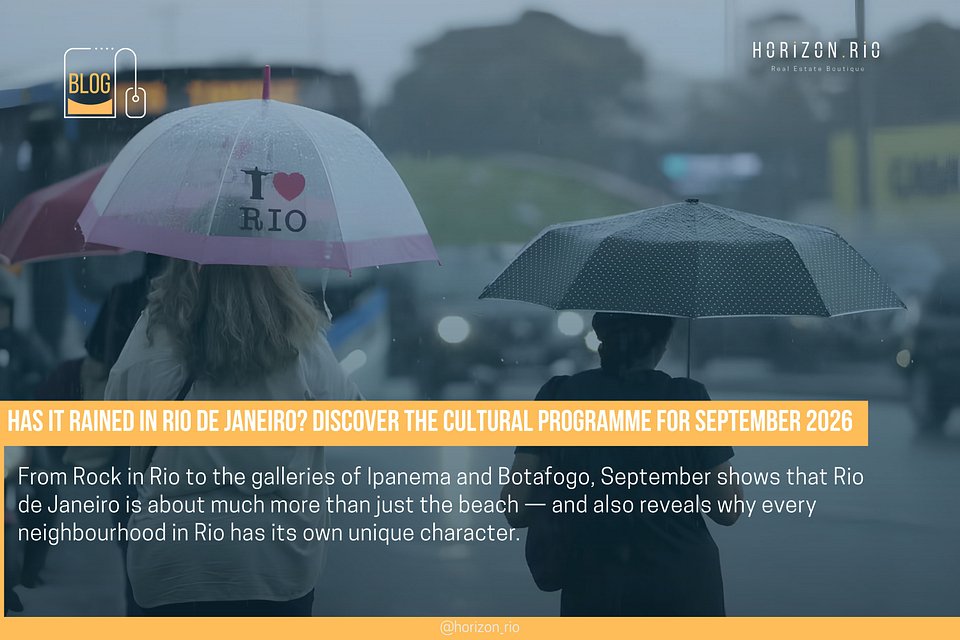
Has it rained in Rio de Janeiro? Discover the cultural programme for September 2026
The rainy, cooler days of late winter in Rio de Janeiro may disrupt visitors’ plans, but they needn’t limit their experience of the city. In September 2026, the cultural programme includes Rock in Rio, ArtRio, exhibitions, music, dance and theatre festivals, and Rio’s first Art Week — a great excuse to take your time exploring the neighbourhoods that also form the heart of Rio’s property market.
Rio de Janeiro is often associated with blue skies, the sea, sand and days spent outdoors. But there is another city hidden behind this picture-postcard image — and it is precisely this city that anyone thinking of living or investing here needs to get to know.
When the rain sets in and temperatures drop, museums, galleries, cinemas, theatres, restaurants and cultural centres take centre stage on the itinerary. September 2026 is a particularly good time to discover this other side of Rio: the month began with Rock in Rio, which runs until 13 September, and continues with a packed cultural programme, including ArtRio and the first edition of Rio Art Week, scheduled for 16 to 27 September.
For anyone visiting Rio on rainy days — whether on holiday or already thinking about moving there — the question is perhaps not ‘what can I do when I can’t go to the beach?’, but rather: what does each neighbourhood have to offer when we look beyond its boundaries?
What does Rio have to offer when it rains?
The first few days of September brought a combination of weather rarely associated with the traditional image of Rio as a tourist destination: rain, cooler temperatures and overcast skies. On 6 September, for example, the city recorded its coldest afternoon of the year so far, at 19.3°C. Unstable weather also characterised the public holiday on 7 September.
For those visiting the city, this might mean postponing a stroll along the seafront, swapping a day at the beach for a visit to a museum, or simply discovering neighbourhoods from a different perspective. And there’s an advantage to this: many of Rio’s most interesting cultural events take place precisely away from the beach — on the very same streets where some of the city’s best places to live are to be found.
Rock in Rio: music even in the rain
Rock in Rio is one of the major events on the Rio de Janeiro calendar and, in 2026, it will take place on 4, 5, 6, 7, 11, 12 and 13 September at the Olympic Park in Barra da Tijuca. The first part of the festival has already shown that rain does not necessarily spoil the experience: the audience braved changeable weather on some days, whilst artists such as Calvin Harris, BaianaSystem, Gilberto Gil and Elton John took to the festival stages.
The second weekend also features acts such as Stray Kids, Jamiroquai, Maroon 5, Demi Lovato, J Balvin, Mumford & Sons, Halsey and Twenty One Pilots, as well as a line-up of Brazilian artists including Criolo, Daniela Mercury, Olodum, João Gomes, Ivete Sangalo and Marina Sena.
More than just a music festival, Rock in Rio transforms the city for a few days: hotels, restaurants, transport, shops and holiday rentals all start to welcome visitors drawn by the event. It is also a practical example of something that anyone investing in property in Rio already knows: the city’s cultural calendar has a direct impact on demand for short-term accommodation.
September puts art at the heart of Rio
For those who prefer a more laid-back programme to a music festival, September offers another option: exploring the city’s contemporary art scene. ArtRio, now in its 16th edition, takes place between 16 and 20 September at Marina da Glória and forms part of an even wider cultural programme spread across Rio, with exhibitions and activities in neighbourhoods such as Ipanema, Leblon, Botafogo, Gávea, Lagoa and the city centre.
This reveals an interesting feature of Rio: art is not concentrated in a single cultural district — nor is the city’s most interesting property market. In Ipanema, galleries such as Nara Roesler and Galeria de Arte Ipanema are opening new exhibitions right now in September. In Botafogo, venues such as Athena are bolstering a contemporary art scene that has developed hand in hand with the neighbourhood’s rise in value in recent years. In Gávea, between Silvia Cintra + Box4 and Anita Schwartz, the proximity to the Lagoa and the Jardim Botânico helps to explain why the area remains among the most sought-after by those seeking a good quality of life without sacrificing a central location.
For anyone considering where to live or invest, following this sort of itinerary is also a way of getting a feel for each neighbourhood — far beyond what any property listing can show.
Curious about the potential for property value growth in the southern districts? Check out Horizon Rio’s Sales Barometer.
Rio Art Week is set to transform the city into a major cultural circuit
One of the highlights of September will be the first Rio Art Week, taking place from 16 to 27 September. The initiative brings together more than ten festivals and a variety of artistic disciplines in a programme spanning museums, cultural centres, theatres and other venues across the city — over a thousand hours of activities, most of which are free, spread across some 120 cultural venues.
The programme includes visual arts, music, theatre, dance, performance art, film and educational activities. Among the events featured are ArtRio, the Panorama Festival, the International Circus Festival, the MIMO Festival, FLUP and the Zózimo Bulbul Black Cinema Festival.
Rather than concentrating the programme in a single venue, the Week encourages visitors to explore the city, connecting different neighbourhoods. For visitors — and for those with their eye on a future home in Rio — this means that a rainy day can become an opportunity to discover a part of the city that doesn’t usually feature on a first-time visitor’s itinerary, but which is very much on the radar of those in the know when it comes to property here.
Art, carnival and Rio de Janeiro identity at MAM Rio
Among the highlights of the programme is ‘Carnival as a Method’, an exhibition opening to the public on 19 September at the Museum of Modern Art in Rio de Janeiro, at Aterro do Flamengo. The exhibition explores the creative processes involved in staging samba school parades and brings together previously unseen works by six carnival designers, as well as historical pieces by figures such as Maria Augusta, Rosa Magalhães and Joãosinho Trinta.
This exhibition is particularly representative of Rio because it treats Carnival not merely as entertainment, but as an artistic language, a creative process and part of Brazil’s cultural identity. And perhaps that is precisely the best reason to explore the city’s cultural programme: it helps us to understand Rio beyond its scenery — and, for those thinking of living here, beyond the square metre.
What to do on a rainy day in Rio?
Rain doesn’t have to mean spending the day indoors. Depending on the neighbourhood and each visitor’s preferences, there are different ways to enjoy the city.
For art lovers: galleries in Ipanema, Leblon, Botafogo and Gávea, as well as museums and cultural centres, are a great way to spend a few hours exploring exhibitions. ArtRio and the programme of events leading up to and accompanying the fair make September a particularly interesting time for those interested in contemporary art.
For music lovers: as well as Rock in Rio, September brings a host of festivals and performances across a range of genres. Rio Art Week also features music in its programme, whilst the MIMO Festival takes place on 19 and 20 September.
For architecture enthusiasts: a cloudy day can also be a good opportunity to take a more leisurely look at Rio’s architecture — from modernism to contemporary architecture, including the historic buildings of the South Zone.
For food lovers: restaurants, cafés, bars and markets are also part of the Rio experience. A rainy day can be the perfect excuse to explore neighbourhoods beyond the traditional beach itinerary.
See also: Why is the Neighbourhood Experience Redefining Long-Term Rentals in Rio de Janeiro?
Why explore Rio beyond the beach?
Rio’s strength lies in the combination of different experiences. The beach is an essential part of the city’s identity, but it is not the only one. Music, art, architecture, gastronomy, carnival, cinema and nightlife also help to shape the character of Rio’s neighbourhoods.
Ipanema, for example, is world-renowned for its beach, but also has a history linked to Bossa Nova, literature, fashion and the arts. Botafogo has developed its own cultural and gastronomic scene, with property values rising in line with this trend. Lagoa combines scenery, heritage and cultural facilities. Gávea is home to universities, art galleries and one of the city’s most popular green spaces.
It is this diversity that makes a neighbourhood so much more than just an address. At Horizon Rio, we design each development with the surrounding area in mind, not just the property’s floor plan — understanding the character of each neighbourhood is just as important as knowing its prices, infrastructure and potential for appreciation.
Rio de Janeiro remains an interesting place when the sky clouds over
Rainy days may change the way you experience Rio, but they needn’t detract from the experience. In September 2026, the city offers a particularly rich mix: one of the country’s biggest music festivals, one of Brazil’s leading contemporary art fairs, a new week dedicated to the arts, and a cultural programme spread across different neighbourhoods.
The beach can wait. In the meantime, there’s a wealth of galleries, museums, music, architecture and cuisine to discover in Rio — and, for those already thinking about their next move, an invitation to explore the neighbourhoods where Horizon Rio is developing properties designed for those who want to live (or invest) in the city, with the freedom to rent them out on a short-term basis whenever they wish.
FAQ — What can you do in Rio de Janeiro when it rains?
What to do in Rio on rainy days?
Museums, art galleries, cultural centres, restaurants, cinemas, theatres and music events are some of the main options. In September 2026, the programme includes Rock in Rio, ArtRio and Rio Art Week.
Does Rock in Rio go ahead even if it rains?
Yes. The festival goes ahead as scheduled even in rainy conditions, unless the organisers announce specific changes. In 2026, some of the first few days of the event were marked by rain, but this did not prevent the concerts from taking place.
What is Rio Art Week?
It is a new cultural initiative taking place from 16 to 27 September 2026, bringing together various festivals, exhibitions, performances and artistic activities at cultural venues across Rio.
Is September a good month to visit Rio de Janeiro?
Yes. September marks the transition from winter to spring and combines a packed cultural programme with the possibility of cooler, rainier days. For those who enjoy art, music, food and events, the month offers plenty of alternatives to the beach.
Where can I find Rio’s cultural programme?
The ArtRio programme brings together art exhibitions and events across various venues in the city, whilst platforms such as Visit Rio and the official programme for Rio Art Week help visitors keep track of the month’s main events.
Written by: Laura Gnr (Journalist) | Horizon Rio — Real Estate Boutique
Fontes: ArtRio; Rock in Rio; Blog Horizon Rio
Instagram: @horizon_rio