HORIZON RIO IMOBILIARIA LDTA
How the Rio lifestyle influences property prices in Rio de Janeiro
When the city reveals its true worthDates such as St George’s Day help to reveal an essential aspect of Rio de Janeiro: the way the city is experienced.
Amid religious celebrations, street gatherings and activities that span different neighbourhoods, what we see is not merely an isolated event, but a pattern. There is a recurring ability to transform culture into an urban experience — something that defines the relationship between the city and those who inhabit it, even if only temporarily.
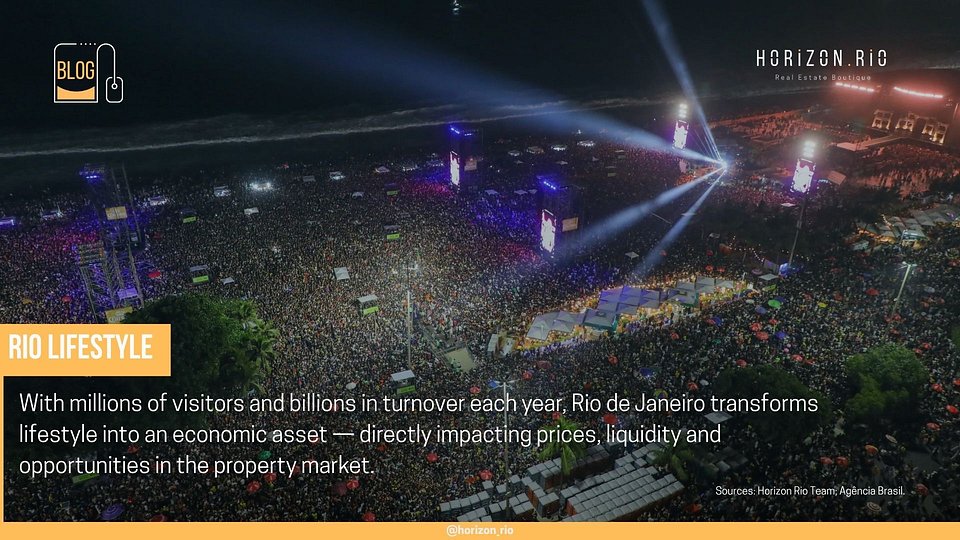
This pattern is repeated throughout the year. Major concerts, festivals and international events reinforce Rio’s status as a global stage. This trend is backed up by the figures: in 2025, international tourism grew by 44.8%, with over 2.1 million foreign visitors. By January 2026, the city had maintained its upward trajectory, with a further increase of 17%.
At first glance, these are separate events. Viewed together, however, they reveal the same phenomenon: when Rio presents itself as an experience, the market responds.
See also: SALES — Horizon Rio Barometer | March 2026: steady growth and an increasingly selective market
Why is location alone not enough to explain property values in Rio?
For decades, the property market has been structured around two key criteria: location and floor area. In Rio, these factors remain relevant, but they are no longer sufficient to explain how value is determined.
The city operates on a broader principle, whereby a property’s performance is directly linked to its ability to blend in with the surrounding lifestyle.
An apartment in Copacabana, for example, is not merely a well-located property. At times of high footfall – driven by events and tourism – it comes to occupy a strategic position within a system that combines culture, the economy and international traffic.
This sort of variation is rarely mentioned in a floor plan or an advertisement, but it directly influences the perceived value, the time it takes to sell, and the property’s liquidity.
Experience, usage and visibility: the mechanism behind valuation
To understand what underpins property values in Rio, one must consider three factors that operate simultaneously.
The first factor is the experience. Properties located in areas with a vibrant urban life — close to the beach, culinary hotspots or cultural attractions — tend to attract greater interest, not only because of their location but also because of the range of possibilities they offer.
The second factor is usage. In a city with a constant flow of visitors, the flexibility to switch between residential use and short-term rentals maximises the property’s potential and creates new sources of income. This trend is backed up by the figures: in the first half of 2025 alone, tourism generated around R$ 14.5 billion for Rio de Janeiro’s economy.
The third factor is visibility. Rio is a global destination, and its international profile—boosted by events, media coverage and tourism—sustains demand from overseas visitors, who often have greater purchasing power, directly impacting the mid-range and luxury segments.
Which neighbourhoods reflect this trend?
This combination of factors manifests itself in a distinct way in each part of the city.
In Ipanema, property values are closely linked to the lifestyle. The interplay between the beach, local shops and constant footfall creates an environment of sustained demand, striking a balance between personal use and investment.
In Leblon, the shortage of supply and the more selective profile of buyers tend to lead to greater stability. Property values rise more steadily, with fewer sudden fluctuations.
In Copacabana, however, volume is the key factor. High turnover, driven by tourism and major events, favours strategies focused on liquidity and income generation. During the summer, the city welcomes around 5 million visitors during the season, which directly drives demand for short-term rentals.
We think you’ll like this: Discover the best places to stay in Rio
A continuous process — rather than a one-off
The impact of events such as concerts and festivals is not limited to the periods in which they take place. In practice, what we see is a pattern that repeats itself over time.
In recent years, Rio has established a programme that consistently combines major events, international tourism and global visibility. At certain times in 2025, growth in international tourism exceeded 50%, underscoring that this is not a matter of isolated peaks, but a consistent trend.
This steady flow sustains demand, contributes to price stability and reduces the time it takes for properties to be snapped up in strategic areas.
It is not, therefore, a one-off occurrence, but a pattern — and it is patterns that, in the long run, determine value.
What’s changing in the way we shop or invest
This interpretation significantly changes the way a property is valued.
The analysis no longer focuses exclusively on physical attributes but now takes into account the context in which the asset is situated: its adaptability, its potential for use and the dynamics of demand in its surrounding area.
For those looking to maximise income, areas with higher footfall and visibility tend to offer more opportunities. For those prioritising housing, factors such as stability and quality of life take centre stage. Hybrid strategies, on the other hand, require a balance between these two factors.
The value lies in the experience that the property offers
At Horizon Rio, we understand that the value of a property in Rio de Janeiro cannot be assessed in isolation.
It needs to be understood within a broader context, where location, usage, demand and lifestyle intersect in a dynamic way.
For this reason, the curatorial approach goes beyond traditional criteria. It takes into account not only the building itself, but also its place within the city — its ability to adapt to changing trends, respond to different uses and remain relevant over time.
Rather than simply selecting properties, the aim is to identify assets that fit within this framework: properties that do not merely occupy a physical address, but actively contribute to what makes Rio one of the world’s most unique markets.
Ultimately, understanding the value of a property in Rio de Janeiro means recognising that it lies not only in the built environment, but in what happens around it — and in the way the property connects with these dynamics.
Frequently Asked Questions (FAQ)
Do events really influence the property market in Rio?
Yes. They boost demand in the short term and enhance the city’s international profile, contributing to price appreciation and liquidity in the medium and long term.
Which neighbourhood is best suited for investment with a focus on rental income?
Areas with high tourist demand, such as Copacabana, tend to offer higher tenant turnover and greater potential for short-term rentals.
Does lifestyle really affect property prices?
Yes. In Rio, the experience associated with the property — access to the beach, city life and events — is a key factor in determining its value.
Prepared by: Horizon Rio — Real Estate Boutique
Sources: Horizon Rio team; Agência Brasil.
Instagram: @horizon_rio