HORIZON RIO IMOBILIARIA LDTA
Why did Rio de Janeiro regain international attention in the property market in 2026?
How has the international perception of Rio de Janeiro changed?
For many years, Rio has occupied an ambiguous position in the international imagination: whilst it was globally recognised for its lifestyle and urban landscape, it was also perceived as a property market that was more difficult for foreign investors to navigate.
In recent years, however, a number of factors have once again drawn international attention to the city.
These include:
growth in international tourism in Brazil;
strengthening the short-term rental market;
the global expansion of remote working;
growing demand for cities associated with quality of life;
appreciation in the value of properties located in areas with limited supply.
In practice, Rio has come to feature more prominently in discussions relating to lifestyle, relocation and second homes.
Why have international investors turned their attention back to Rio?
1. International tourism in Brazil has reached record levels
In 2025, Brazil recorded its highest number of international tourists in recent history, exceeding 9 million foreign visitors, according to data from Embratur and the Ministry of Tourism.
Rio de Janeiro remains one of the country’s leading international tourist destinations, particularly among visitors from Europe, North America and Latin America.
This trend is significant for the property market because tourism often acts as a gateway to future investment, particularly in markets linked to second homes and holiday rentals.
2. Rio’s property market continues to rise in value in 2026
Recent data from FipeZAP suggest that property prices in Rio de Janeiro will continue to rise in 2026, albeit at a more moderate pace than in previous cycles.
This trend helps to foster a perception of a more stable and selective market, particularly in the city’s most sought-after neighbourhoods.
At the same time, demand remains more concentrated in the property market:
well-located;
retired;
close to the beach;
with an open view;
located in regions with limited supply.
Neighbourhoods such as Leblon and Ipanema continue to operate under conditions of relative scarcity, as they have a limited supply of new developments and historically high demand.
Does the Rio de Janeiro lifestyle influence property prices?
Factors linked to the urban experience and quality of life are increasingly influencing property decisions in various international markets.
In this context, Rio shares characteristics often associated with global lifestyle cities:
a strong connection between nature and urban life;
tropical climate;
outdoor life;
a coastline that is an integral part of city life;
international cultural significance.
As observed in global cities associated with urban and coastal lifestyles — such as Lisbon, Barcelona and Miami — lifestyle factors have come to exert a growing influence on the property market in recent years.
Rio possesses urban characteristics that often place the city at the centre of international discussions on lifestyle, global mobility and second homes.
Which neighbourhoods attract the most international interest?
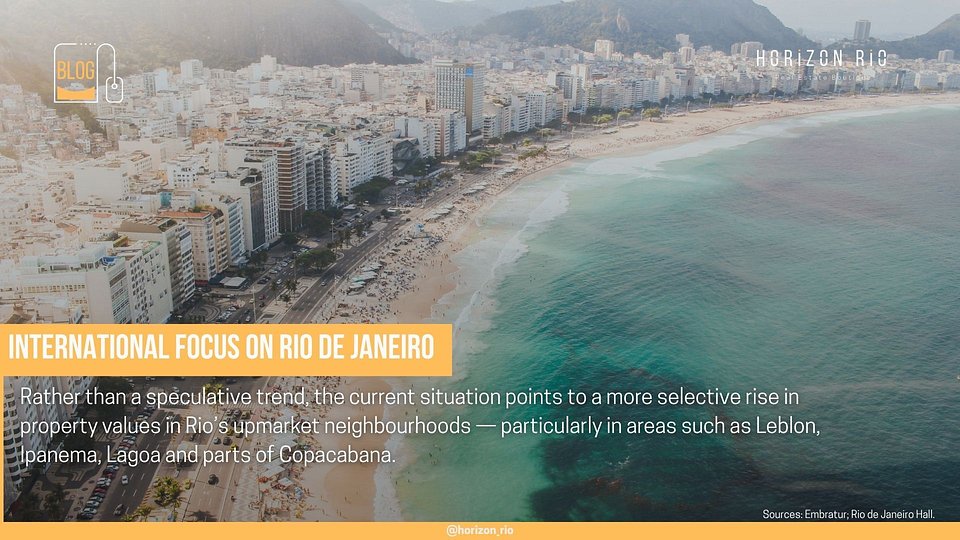
A significant proportion of international demand remains concentrated in the upmarket neighbourhoods of the South Zone.
Among the main ones:
Leblon;
Ipanema;
Lagoon;
Copacabana;
specific areas of Botafogo.
The most sought-after properties usually share characteristics such as:
open view;
close to the beach;
contemporary architecture;
services;
potential for short-term rentals.
There is also growing interest in hybrid properties, which can serve both as temporary homes and as flexible-use assets.
Does the exchange rate still favour international buyers?
Generally speaking, yes.
Despite recent fluctuations, the real remains relatively undervalued against the dollar and the euro compared with previous periods, which could boost the purchasing power of international investors in the Brazilian market.
In practice, this means that premium properties in Rio are still priced lower than those found in some international luxury markets with a similar urban and coastal profile.
Could Rio make a name for itself in the global second-home market?
The global rise in remote working and international mobility has boosted the importance of the second-home market in recent years.
Against this backdrop, cities with strong cultural appeal, a favourable climate and a limited supply of premium properties have begun to attract more attention from international buyers.
Rio shares some of these characteristics:
tropical climate;
international events calendar;
strong cultural identity;
established market for short-term rentals;
upmarket neighbourhoods near the coast.
This helps to explain the growing international interest in issues such as:
relocation;
flexible living;
lifestyle investment;
holiday rental.
What might this development mean for the Rio de Janeiro property market?
The most noticeable effects so far are mainly evident in the city’s premium sector.
These include:
a greater focus on assets considered rare;
increased demand for renovated properties;
the growing professionalisation of the holiday rental sector;
greater integration between the tourism and property sectors.
At the same time, the market is becoming more selective.
Factors such as location, views, the standard of refurbishment, architecture and operational potential have come to carry even greater weight in the perception of a property’s value.
How can one navigate the current situation in the Rio de Janeiro property market?
With Rio once again gaining greater international visibility, understanding the city is no longer just a matter of knowing its location; it now requires an understanding of market trends, global behaviour and strategic asset analysis.
In a more selective market, factors such as appreciation potential, usage profile, short-term rental operations and lifestyle experience are increasingly influencing property decisions.
It is in this context that companies specialising in Rio de Janeiro’s luxury property market tend to become even more prominent, particularly those capable of bridging the real estate sector, the hospitality industry and an international outlook.
Horizon Rio closely follows this trend, specialising in property curation and analysing the changes that are shaping Rio de Janeiro’s position in the contemporary property market.
FAQ — Property investment in Rio de Janeiro in 2026
Can foreigners buy property in Brazil?
Yes. Foreigners can purchase urban property in Brazil, including flats and houses in Rio de Janeiro.
Which neighbourhoods in Rio are most attractive to international investors?
Leblon, Ipanema, Lagoa and parts of Copacabana remain among the neighbourhoods attracting the most international interest, particularly for properties near the beach.
Will the property market in Rio be on the rise in 2026?
Yes. Data from FipeZAP show that house prices in Rio de Janeiro will continue to rise in 2026, albeit at a more moderate pace.
Does international tourism influence the property market in Rio de Janeiro?
Yes. The growth in international tourism may increase demand for short-term rentals, second homes and properties designed for mixed residential and rental use.
Produced by: Horizon Rio — Real Estate Boutique
Sources: Embratur; Ministry of Tourism; FipeZAP — Residential Sales Index; Central Bank of Brazil.
Instagram: @horizon_rio