
HORIZON RIO IMOBILIARIA LDTA
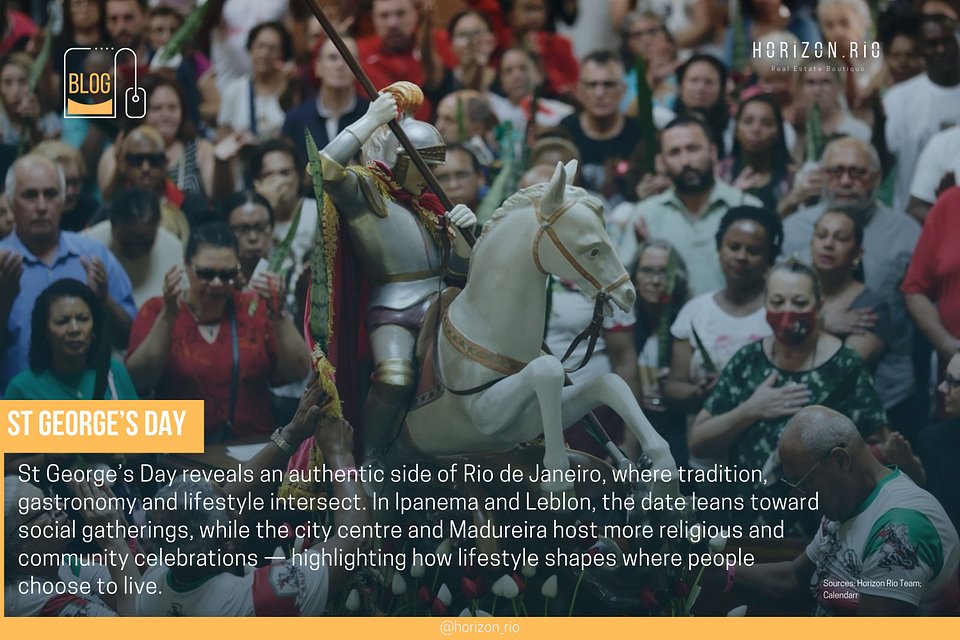
Where to celebrate St George’s Day in Rio de Janeiro: tradition, neighbourhoods and lifestyle in 2026
Celebrated on 23 April, St George’s Day changes the pace of life in Rio de Janeiro. Between the public holiday and the optional day off, the city slows down — yet remains bustling, with busy streets, long gatherings and a programme that blends faith and community spirit.
More than just a religious holiday, the day reveals an everyday aspect of the city, evident in the way spaces are used and shared.
Why is St George’s Day significant in Rio de Janeiro?
Devotion to Saint George in Rio is characterised by syncretism with Ogum, reflecting the city’s cultural roots.
Throughout the day, different activities take place:
churches full from early on
constant activity surrounding religious celebrations
a symbolic presence on the streets
At the same time, there is one thing that links these experiences: the São Jorge feijoada.
Served in homes, bars and restaurants, it turns the holiday into a communal occasion. More than just a traditional dish, it serves as a social and informal gathering place.
See also: EDITORIAL: The new luxury in Rio: when square footage is no longer the main focus
How is St George’s Day celebrated across Rio’s neighbourhoods?
The event isn’t confined to a single location; it takes place across the city and takes on different forms depending on the neighbourhood.
In the South Zone, particularly in Ipanema and Leblon, the focus is on the social experience. Busy restaurants, get-togethers with friends and an urban vibe centred around food.
In the town centre, the proximity to the church dedicated to the saint heightens the religious atmosphere throughout the day.
In Madureira, however, the celebration is more directly linked to cultural and religious traditions, with strong community involvement.
This diversity shows that Rio offers many different ways of celebrating the same occasion.
We think you’ll like this: Wonders beyond the beaches: Check out the best tours to do in the Marvelous City
What does each neighbourhood in Rio have to offer on St George’s Day?
The analysis is no longer just about where to celebrate — it now considers where this kind of experience is repeated in everyday life.
In Ipanema:
high walkability
integration of the beach and local businesses
active social life
In Leblon:
a more intimate setting
high-quality services
lower urban density
Meanwhile, Centro and Madureira offer:
greater cultural presence
strong sense of community
a closer connection with local traditions
Each region offers not just a type of housing, but a different kind of urban experience.
A city to live in, not just to visit
St George’s Day is not just a date on the calendar. It encapsulates one of Rio’s defining characteristics: the ability to turn tradition into an everyday experience.
More than just a one-off event, this kind of experience reveals something fundamental about the city — Rio is defined not only by its settings, but by the way in which they are occupied, shared and experienced over time.
It is at this point that the city ceases to be a destination and becomes part of everyday life.
And understanding this dynamic is also the first step towards recognising how lifestyle, location and experience are interconnected — not only in terms of how we live, but also in terms of how we choose where to live.
Throughout the year, it is these moments—almost invisible to outsiders—that define the experience of living in Rio.
It is precisely through this deeper understanding of the area that Horizon Rio distinguishes itself: not merely by showcasing properties, but by interpreting the city through the lifestyle it offers.
Because, ultimately, choosing where to live in Rio isn’t just a decision about property — it’s a choice about how you want to experience the city every day.
Frequently asked questions about St George’s Day in Rio
Where can you celebrate St George’s Day in Rio de Janeiro?
Neighbourhoods such as Ipanema and Leblon offer a more gastronomic and social experience, whilst areas such as Centro and Madureira are the focus of religious and community celebrations.
Is St George’s Day a public holiday in Rio?
Yes, 23 April is a state public holiday in Rio de Janeiro.
What is the connection between Saint George and Ogum?
This date reflects the religious syncretism between the Catholic saint and the deity of African-based religions.
Organised by: Horizon Rio — Real Estate Boutique
Sources: Curated by Horizon Rio; Calendarr
Instagram: @horizon_rio