HORIZON RIO IMOBILIARIA LDTA
EDITORIAL: The new luxury in Rio: when square footage is no longer the main focus
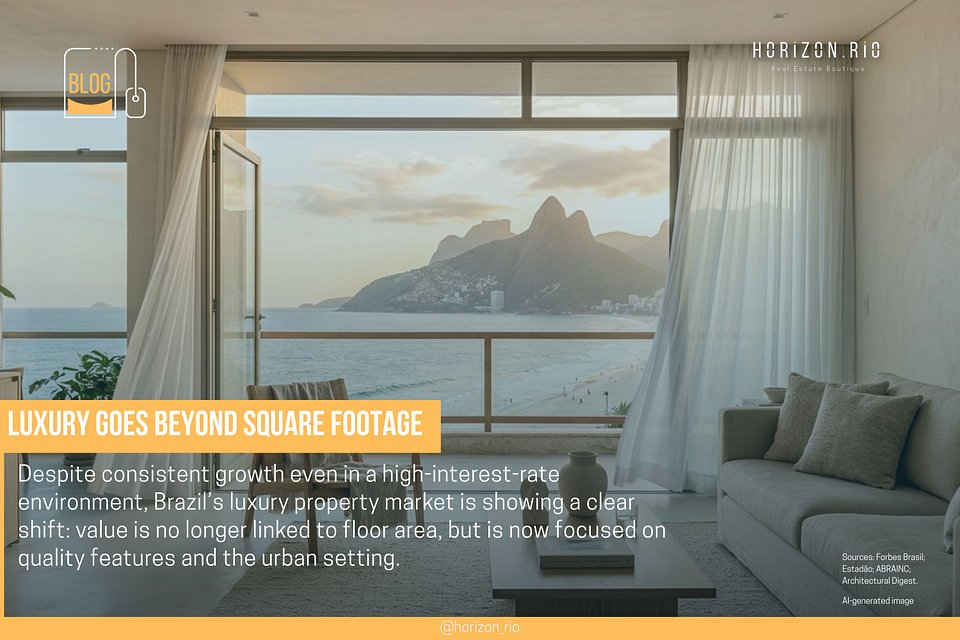
For decades, the luxury property market operated on an almost unquestionable principle: size was synonymous with value. More square metres meant greater status, greater exclusivity and, naturally, higher prices.
By 2026, this logic still holds true, but it is no longer sufficient to explain market behaviour.
What we are seeing today is not the end of floor area as a criterion, but its loss of central importance. In the luxury market, the square metre is beginning to behave like a commodity.
What defines a luxury property today?
The Brazilian mid-to-high-end property market ended 2025 with 20% growth, reaching around R$30 billion in new developments, according to ABRAINC.
More important than the volume is the nature of this expansion. Demand has been concentrated on products with higher added value, in a trend often described as a ‘flight to quality’.
In practice, this redefines the concept of value: it is no longer about acquiring more space, but about buying better.
Why is floor area no longer the main criterion?
Even against a backdrop of high interest rates, the luxury property sector has maintained a consistent performance — driven by buyers who are less reliant on credit and more focused on quality criteria.
This behaviour alters the decision-making hierarchy.
Property size remains a factor, but it is taking a back seat to factors such as floor plan efficiency, user experience and compatibility with one’s lifestyle. A larger property, in and of itself, no longer guarantees value.
How does lifestyle affect a property’s value?
This transformation is also perceptual.
Publications such as Architectural Digest point out that factors such as environmental comfort, privacy and integration with the surrounding area have come to play a central role in determining value in the luxury property sector.
In Brazil, this trend takes on an additional dimension: property is no longer seen merely as a financial asset, but is now understood as a direct extension of everyday life.
In this context, value is experience.
Has well-being become a prerequisite in the luxury market?
The data suggests that this is the case — and that it is a structural issue.
Natural ventilation, natural light, quiet surroundings and proximity to open spaces are no longer unique selling points; they have become standard features expected in this sector.
More than just individual features, these elements reflect a shift in priorities: everyday life within the property has become just as important as its long-term appreciation.
Why is this transformation even more evident in Rio de Janeiro?
In Rio, this change is not just a trend – it is gaining momentum.
The city has always operated on the basis of a direct link between property and lifestyle. What has changed now is that this logic is no longer subjective but is reflected in concrete terms in market data.
Neighbourhoods such as Ipanema and Leblon are highly valued not only for the quality of their properties, but also for the urban experience they offer: the ability to get around on foot, proximity to the beach, access to amenities and a distinctive way of life.
In this context, localisation ceases to be a feature and becomes an integral part of the product itself.
Is it better to buy a larger property or one in a better location?
The figures help to put this change into perspective.
The luxury and ultra-luxury market was worth R$52.2 billion in 2025 across Brazil’s state capitals, representing a 35% increase on the previous year, according to a survey by Brain Inteligência Estratégica published by Forbes Brasil.
Although it accounted for less than 4% of units sold, this segment accounted for almost 30% of the total value of transactions in the residential market.
The picture is clear: value is becoming increasingly concentrated — and less spread out in terms of volume.
How should luxury property be valued in 2026?
With a more sophisticated market, the analysis is no longer purely technical.
In addition to physical characteristics, factors such as the urban context, the quality of the surroundings, the potential uses of the property, and how well it fits the buyer’s lifestyle also come into play.
Valuing a property these days requires a degree of interpretation.
What has changed in the concept of luxury property?
Luxury has not disappeared; it has simply been redefined. What was once associated with scale is now rooted in quality, context and experience. A property is no longer merely a space; it has become the interface between the individual and the city.
In Rio de Janeiro, where living has always been an essential part of the city’s character, this transformation merely brings to light a change that is already underway.
Viewership still matters — but it no longer dominates the narrative.
In this context, market analysis ceases to be merely analytical and becomes strategic — requiring curation, a broad repertoire and the ability to interpret nuances that go beyond the figures.
Horizon Rio — Real Estate Boutique operates on this principle by precisely matching properties to lifestyles — interpreting market conditions, the potential of each asset and how well it aligns with the buyer’s profile. Rather than simply facilitating transactions, our role is to explain how each property fits into the city’s fabric and the life plans of those who choose Rio de Janeiro as an investment.
Produced by: Horizon Rio — Real Estate Boutique
Sources: Forbes Brazil; Estadão; ABRAINC; Architectural Digest.
Instagram: @horizon_rio